
Choosing the right paint for your home is not simply about selecting a beautiful colour. Interior and exterior walls have completely different requirements because they are exposed to different conditions. If you are planning a home renovation or new painting project in Ambala, understanding the difference between interior vs exterior wall painting can help you choose better materials, finishes and painting techniques.
Interior walls are mainly designed for beauty, comfort and easy maintenance, while exterior walls need protection from sunlight, rain, dust, humidity and changing weather conditions.
In Ambala, where homes experience hot summers, monsoon rainfall and winter moisture, choosing the right type of wall paint becomes even more important.
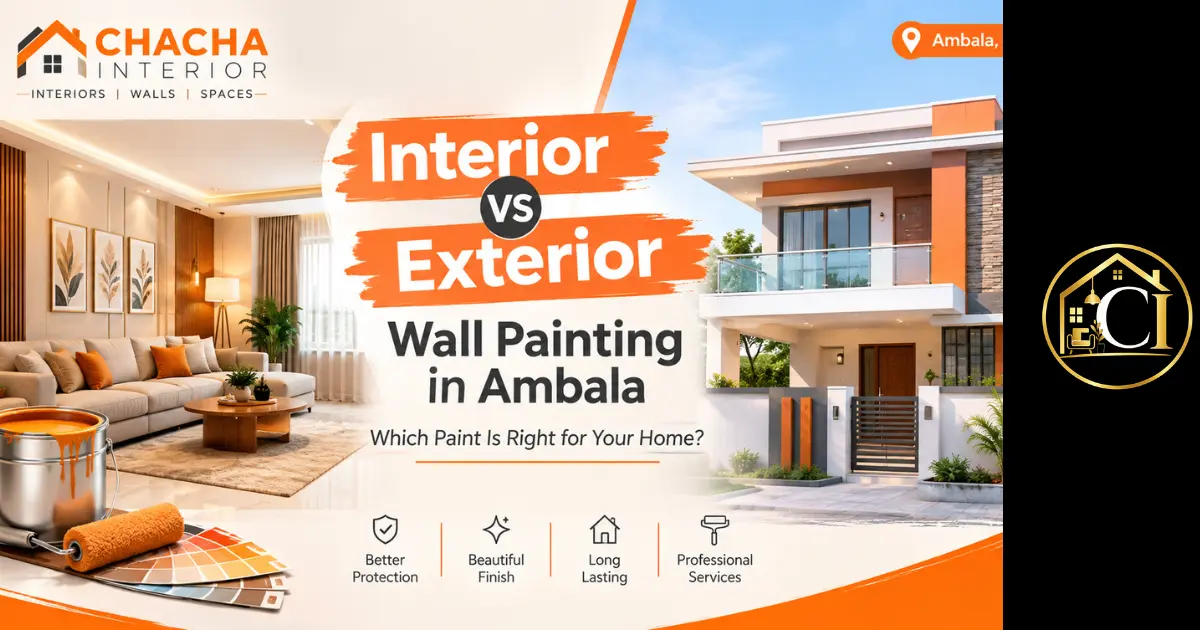
| Post Title | Interior vs Exterior Wall Painting in Ambala |
| Publish Date | 13/9/26 |
| Contact For Work | +91 9255824173 |
| Published By | Codeswithsam Team |
Interior wall painting focuses on creating a comfortable, attractive and clean environment inside your home or office.
Living rooms, bedrooms, dining areas, hallways and offices generally require paints that provide a smooth finish, attractive colour and easy maintenance.
For interior walls, homeowners commonly choose finishes such as matte, satin and washable emulsions. The right option depends on the room, lighting, furniture and desired appearance.
A professionally painted interior can:
For smaller rooms, light and neutral shades can help create a more open appearance. Feature walls can also be enhanced with texture paint or wallpaper for a more premium look.
If you are considering alternatives to traditional paint, Chacha Interior also provides wallpaper and decorative wall solutions for homes and offices in Ambala.
Exterior walls are exposed to much harsher conditions than interior walls.
Your home’s exterior has to deal with direct sunlight, rain, dust, pollution, temperature changes and moisture. Therefore, exterior paint needs to provide both attractive appearance and protection.
A good exterior painting system generally involves proper cleaning, crack repair, surface preparation, primer and suitable weather-resistant paint.
Professional exterior painting can help:
For homeowners looking for decorative exterior finishes, textured finishes and specialised wall treatments can also be considered depending on the condition and design of the building.
Although both involve painting walls, the requirements are quite different.
| Feature | Interior Wall Painting | Exterior Wall Painting |
|---|---|---|
| Main purpose | Beauty & comfort | Protection & appearance |
| Exposure | Limited | Sun, rain, dust & pollution |
| Paint requirement | Interior-grade paint | Weather-resistant exterior paint |
| Finish | Matte, satin, washable etc. | Weather-resistant finishes |
| Maintenance | Relatively easier | Requires weather protection |
| Surface preparation | Cleaning, putty, sanding, primer | Cleaning, crack repair, primer & weather protection |
| Colour selection | Based on décor & lighting | Based on elevation & surroundings |
| Main concern | Look & cleanability | Durability & weather resistance |
The biggest mistake homeowners make is assuming that the same paint can be used everywhere. Interior and exterior paints are formulated for different environments, so selecting the correct product is important.
There is no single paint that is best for every room.
For bedrooms and living rooms, homeowners often prefer smooth, elegant finishes. Washable paints can be useful in areas where walls are more likely to get dirty.
When choosing interior paint, consider:
If you want something more decorative than plain paint, texture paint can create an attractive accent wall without changing the entire room.
Exterior walls need products specifically designed to handle outdoor conditions.
When selecting exterior paint, consider:
Proper preparation is just as important as the paint itself. Painting over dusty, damaged or poorly prepared surfaces can result in peeling, uneven colour and premature deterioration.
Whether you are painting an interior room or the outside of your home, preparation should never be skipped.
A professional painting process may include:
1. Site Inspection:
The wall condition is checked before work begins.
2. Cleaning:
Dust, dirt and loose material are removed.
3. Crack Repair:
Visible cracks and damaged areas are repaired.
4. Putty and Sanding:
Interior surfaces may require putty and sanding to achieve a smooth finish.
5. Primer Application:
Primer helps prepare the surface for the final coats.
6. Painting:
The selected paint is applied using suitable tools and techniques.
7. Final Inspection:
The finished walls are checked for coverage, colour consistency and finishing quality.
Professional preparation can help the final paint look cleaner and last longer.
The cost of painting depends on several factors, so there is no fixed price that applies to every property.
Important factors include:
A proper site inspection is therefore a better way to estimate the actual project cost than relying only on a per-square-foot figure.
For larger projects, getting a detailed quotation can also help you understand exactly what is included in the painting work.
If you are renovating your complete house, the order depends on the condition of the property and the other renovation work being carried out.
For a newly constructed house, it is generally better to coordinate painting with other interior work so that freshly painted surfaces are not damaged by later installations.
For an existing property, exterior maintenance may become a priority if the walls show signs of weather damage, cracks or moisture problems.
The best approach is to inspect the complete property and create a painting plan based on actual requirements.
Painting may look like a simple job, but achieving a professional finish requires proper preparation, tools, product knowledge and application techniques.
A professional team can help with:
Chacha Interior has positioned its wall painting service around professional workmanship, experienced teams and complete wall-finishing solutions in Ambala. Its existing wall-painting service content also covers interior, exterior, repainting and decorative finishes.
You don’t necessarily have to use only one wall treatment throughout your home.
A modern home can combine:
For example, you could use a neutral paint colour throughout the living room and add wallpaper or texture to the TV wall.
This creates visual contrast without making the entire space look overly decorated.
Chacha Interior’s existing content also discusses the combination of wallpaper and paint as an option for modern Ambala homes.
Traditional exterior paint is not the only solution for improving the appearance of a building.
Depending on the property and desired appearance, homeowners can consider decorative textured finishes such as stone-like or granule-based finishes.
For example, Chacha Interior also offers content around Madrasi Dana work in Ambala, a decorative exterior finish designed to create a textured, stone-like appearance.
This can be particularly useful when homeowners want their home’s exterior elevation to look more distinctive than a conventional painted surface.
Interior painting is designed mainly for indoor appearance, comfort and maintenance, while exterior painting is designed to withstand outdoor conditions such as sunlight, rain, dust and temperature changes.
It is generally better to use paint specifically designed for exterior conditions. Exterior walls require stronger resistance to weather and moisture.
Both are important. Even premium-quality paint may not perform well if the wall is poorly prepared.
Painting cost depends on area, wall condition, paint quality, number of coats, surface preparation and whether the work is interior or exterior. A site inspection is the best way to receive an accurate quotation.
Yes. Texture paint can be used to create feature walls, accent walls and decorative finishes in living rooms, bedrooms, offices and other interior spaces.
The repainting requirement depends on the paint system, surface condition, weather exposure and maintenance. An inspection can help determine whether repainting is actually necessary.
Neutral, earthy and balanced colours are popular because they complement different architectural styles. The best colour depends on the home’s elevation, surroundings and personal preference.
Professional painting can provide better surface preparation, cleaner application, more consistent finishing and a more organised project, particularly for complete homes or exterior projects.
Planning to refresh your home’s interior or give your exterior a completely new appearance?
Chacha Interior provides professional wall painting and decorative wall-finishing solutions in Ambala and nearby areas.
📞 Call: 9255824173
🌐 Website: https://chachainterior.in/
Get in touch with Chacha Interior for a site inspection, discuss your requirements and choose the right painting solution for your home.